

How Jacobs Supports ADHD in the Workplace: An Employee and Manager Interview
Category: Disability (Learning/Mental/Physical), Neurodiversity

Attention Deficit Hyperactivity Disorder (ADHD) is a health condition that affects both children and adults. In this joint interview, Doug Murray, Cadet Civil Drafter and his manager David Gallagher, Section Leader: Roads and Highways, share their perspectives on ADHD and discuss how we can better support people living with ADHD in the workplace and beyond. Doug and David are based in our Melbourne office, Australia
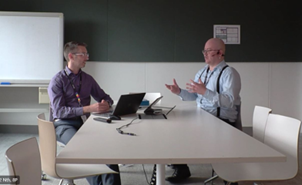
Left to right: David Gallagher and Doug Murray
An Interview with Doug Murray
Tell us more about your journey with ADHD:
When did you discover you had ADHD? How has this affected you?
I had a formal diagnosis of ADHD as a child in the early 90s, but my parents were influenced by the whole “medicating your kids makes you a bad parent” and “kids grow out of it” nonsense. My mother acknowledged my diagnosis in 2019 and I began treatment with meds and targeted therapy in late 2020.
Failure to treat my ADHD with medication and behavioural therapy led me to poor decision making throughout my life that negatively impacted my education, employment and personal relationships. ADHD symptoms manifest on a spectrum of hyperactivity to inattentiveness, differing in severity and presentation person to person. My symptoms are primarily inattentive, which are more commonly associated with sufferers who are women and those assigned female at birth. This has led to a long history of underdiagnosis in these populations because inattentive symptoms are often dismissed as laziness.
What is a common misconception about ADHD from your perspective?
ADHD is not simply a personality type or a behaviour issue. It’s a neurodevelopmental condition that affects how your brain handles things like attention, memory, behaviour and emotions. It can have a very real impact on day-to-day life.
How did you come to work at Jacobs and what were you doing prior to starting?
Much of my adult life was spent trying to establish a career as a musician. Along the way I started but didn’t complete two Bachelor Degrees: Nursing from 2010 to 2015, then Sociology/Linguistics between 2015 and 2016. I was unemployed throughout 2017 and the first half of 2018, before spending two years working in warehousing, which ended in mid-2020.
Having started treating my ADHD at the end of 2020, I gained the confidence to try a tertiary qualification one last time, beginning an Associate Degree in Engineering Technology at RMIT University, where I discovered a passion for Civil computer-aided design (CAD). In mid-2022, David Gallagher and Mahmoud Elsoukmani gave me the opportunity to work part-time at Jacobs while I completed the final semester of my degree.
What accommodations do you have in place to help you be your best at work?
The most helpful accommodations for me come from colleagues understanding that my disability can impact my behaviour and work capacity. That includes being comfortable letting me know if I am being disruptive and allowing extra time and guidance when learning new processes and procedures. I work best when people give me precise and direct instructions. I also experience chronic insomnia related to my ADHD, and Jacobs’ flexible working options, including working from home, mean that I can still contribute effectively to projects when symptoms affect my ability to come into the office.
What would your advice be to anyone working who also has ADHD?
Know yourself and do not be afraid to share your specific challenges and needs with your leadership. In addition, I’ve found that MS Teams and OneNote can be powerful tools for communication and organisation in real time. They help me manage my workload in a way that suits me as I prefer to see things in a mind-map rather than a linear style.
What are a couple of highlights from your time at Jacobs?
My training began as part of the team delivering the New Bridgewater Bridge project in the Australian state of Tasmania. Well before my involvement the project was thoroughly coordinated with easy-to-follow guidelines for best practice, which helped those training me to adapt to my unique educational needs. As mentioned earlier, screen sharing over MS Teams, pasting screenshots and adding notes as a mind map in OneNote helped me maintain focus and develop my skills quickly. Along the way I also discovered a passion for workspace customisation.
Aligned to the goals of our Access Connect Empower (ACE) Network at Jacobs, which exists to support disabled employees, carers and allies, I want to show people with disabilities that they can participate in engineering and its allied professions. There are always ways to adapt physical controls, and customise software to suit individual needs. Nothing is impossible with a 3D printer, gaffer tape and lots of hot glue!
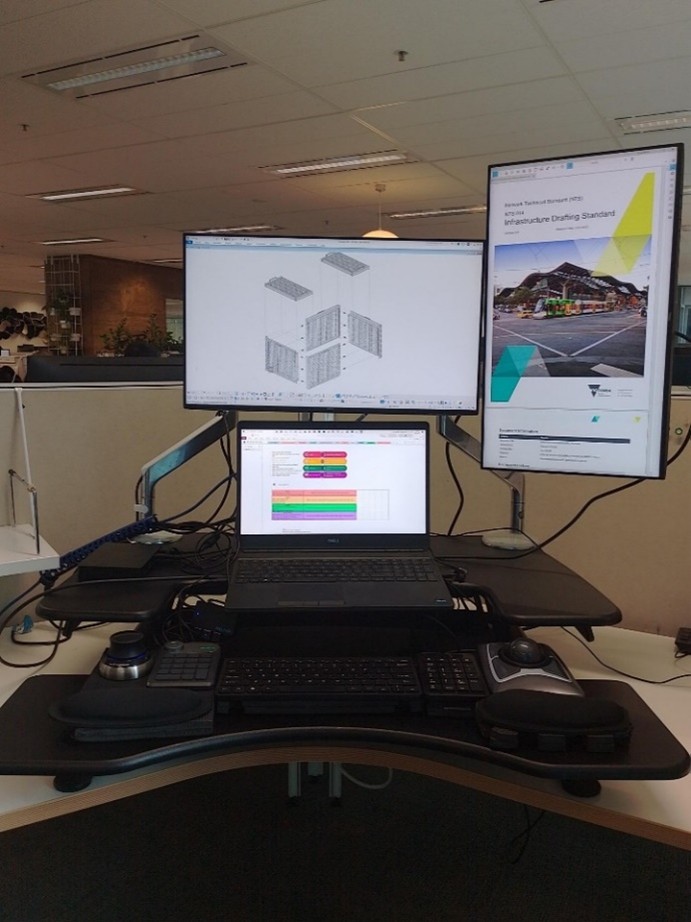
Doug's customised workstation
An Interview with David Gallagher
Tell us about your journey working with Doug and the initial thoughts or concerns you had?
Doug joined our Roads team in Melbourne a little over a year ago. We interviewed for a cadet drafter and Doug was extremely passionate about his studies and particularly with CAD. While there were some reservations about his career history, we felt it was important to give him the opportunity as he had the right attitude and motivation for drafting. I’ll admit that I was a little apprehensive to begin with. I was starting a journey with a new team member, and when Doug shared his ADHD diagnosis, I didn’t feel fully equipped with the knowledge or experience to support him properly. My initial concerns were around potential disruption to the team, unintentionally creating a two-tier environment amongst colleagues or putting Doug in a position that wasn’t workable.
What has worked well from your perspective in helping Doug at Jacobs?
Working with Doug when he joined the team was a unique onboarding experience – there was a lot to learn. The Jacobs office environment was completely new to Doug and so it was a case of starting from the very beginning. With our team leads we have worked through this new environment with Doug. Communication has been one of the key pillars to success including clearly agreeing how and when do we communicate, understanding context in meetings and taking the good / constructive messages and intent from situations and feedback. These were all new experiences and required time and effort to work through them.
My team leads and I are on a journey of understanding Doug’s ADHD and it’s important to remember that it’s a journey for everyone. Patience is required on both sides. The approach for Doug won’t necessarily be a cut and paste match for someone else in its entirety. The ACE network has been a key factor in navigating this journey. It’s been an independent trusted advisor to both Doug and me, providing us with others to talk to and directing us to relevant information and advice.
What advice would you give other managers?
There is lots of useful information out there on ADHD. Review that information with your team member and have an open discussion about what you understand and what you don’t. While the language used around neurodiversity can be somewhat generic in the available information, meaning that it can be difficult for everyone to emote to, the concepts are helpful. Working together, we can both adapt to create an environment that works. Is it easy? Not always. Is it worth it? Absolutely. There is lots to be learned that will help you as a people leader and challenge you to think differently in how you lead your team more broadly.
A final message from David
We are fortunate to work in the environment that we do. It’s sometimes easy to forget that our workplace can be a bubble of generally like-minded people. When someone new brings a different perspective or has a different needs, it encourages another level of awareness. While this can introduce new challenges, it also creates opportunities for learning which ultimately benefit both to you and those you work with.
Find out more about ADHD:

VERCIDA works with over one hundred clients who are committed to creating an inclusive work environment. If you are an employer and interested in working with VERCIDA to promote your culture and inclusion initiatives and attract the best candidates, please email [email protected] for more information.
 Help us find the best workplace for you by sharing more about yourself.
We will never disclose your information with others.
Help us find the best workplace for you by sharing more about yourself.
We will never disclose your information with others.
Learn more about this employer
Jacobs
Inclusive features
- No matching inclusive features