

"I Try to Be the Person I Needed Back Then": Abby Picken on Neurodiversity, Persistence, and Finding Her Place at Sage
Category: Neurodiversity, Training & Development

Created by VERCIDA for Sage
Abby Picken did not arrive at her current role in a straight line. She is a Learning Services Specialist at Sage, where she designs and creates learning content, including live webinars, videos and online courses, that help customers navigate complex financial processes.
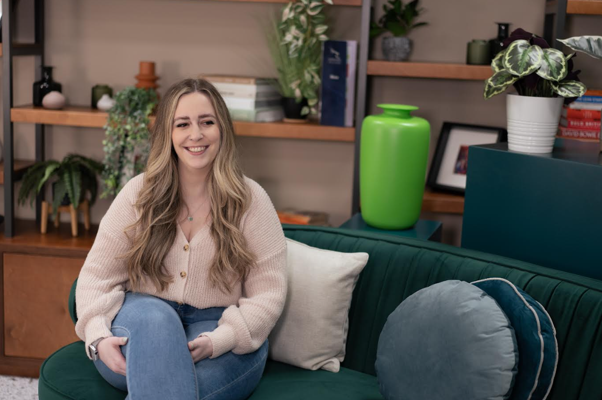
She is also one of three co-leads of Sage’s Ability Network, a community that has more than doubled in membership through the collective efforts of Abby and her fellow co-leads. But before any of that, there were two failed interviews, an associate programme she took on around her day job, and a manager who told her to hold on just a little longer.
"It wasn't plain sailing, I had to work for it, like I have all my life."
Two Diagnoses, One Clearer Picture
Abby was diagnosed with dyslexia at 21, during her master's degree, after a lecturer suggested she seek an assessment. It was late in the year, and she received limited support as a result. But the diagnosis still mattered.
"People assume dyslexia is about spelling, or letters moving around on a page. For me, it's about structure and short-term processing memory. If someone's giving me instructions, I can't hold the upcoming sentence in my head while I'm writing down the current one."
Her ADHD diagnosis came four years later, prompted by a workplace coach who noticed patterns in how Abby described her working day. A GP referral followed, helped along by something unexpected: her mother had kept every school report.
"My psychiatrist said he could have diagnosed me just from those reports," Abby recalls. The recurring comments, easily distracted, would chat to others, couldn't sit still, suddenly read very differently. "I just thought, how was this not picked up?"
The diagnoses brought relief, but also a complicated grief. "I felt angry that I'd been failed by a system where so much research had been done on boys and their presentation, and not on how girls mask and cope differently." She found her way through a Facebook support group for women in the UK with ADHD, and the sense of recognition it offered. "I was like, oh my God, I'm actually not alone."
What Actually Works (and What Doesn't)
Abby is candid about the gap between the support neurodivergent people are typically handed and what helps them.
"When you get a dyslexia diagnosis, you're immediately given Dragon or some dictation software," she says. "I've never found that useful. My challenge isn't the physical act of writing. It's structure."
What has worked is more specific. Her calendar is colour-coded by category, each type of task assigned its own colour so she can read a week at a glance without decoding it. She uses Microsoft Planner to organise tasks into project-specific buckets, with email reminders that keep her inbox clear and her attention focused. More recently, she has started using Microsoft Copilot to help with scriptwriting.
"I used to really procrastinate on scripts because getting started was the hardest part," she explains. "Copilot has made that less daunting. I've had to learn how to prompt it well, but it works with how my brain operates, not against it."
She is careful to frame these as personal solutions, not prescriptions. "When people come to me through the Ability Network, I share what I do and say: this might not work for you, but here's what works for me. Try it and see."
The Role That Changed Everything
When a role came up in Sage's learning team, Abby applied despite having no direct instructional design background. She did not get it. She joined an associate programme, coming in early to work on projects around her existing shifts. She applied again when another position opened. She did not get that one either, narrowly beaten out by candidates with more experience.
"I was devastated," she says. "With ADHD, emotional regulation is genuinely hard. It really took its toll."
Her manager asked her to hold on. Two weeks later, a third position became available, and he offered it to her without a further interview, based on everything he had seen from her work in the associate programme.
The role was live webinar delivery, something she had never done. She took it anyway.
"It has been the best thing I have ever done," she says. "You're presenting to hundreds of people, but it plays to exactly how my brain works. I can hyper-focus, I can connect with people, and there are no essays."

High Performance, Honestly Defined
Abby resists the framing of neurodiversity as a superpower. "I don't really like that," she says plainly. What she describes instead is something more grounded: passion-driven focus, and the kind of performance that follows when work has genuine stakes.
Over the past year, she has been the subject matter expert for Sage's Making Tax Digital programme, taking on one of the more complex and anxiety-inducing transitions customers face. When she spotted that customers were worried as the mandate approached, she turned around an additional webinar in a week, half the usual time.
"I could see the worry coming through in the Q&A feedback," she says. "I just knew I needed to get something out. I was so determined. That's what hyperfocus actually looks like for me, it's not magic, it's caring enough about something to go flat out."
Building a Community
When Abby joined the Ability Network, she had attended precisely one session. She immediately asked if she could co-lead it!
Under the co-leadership of Abby and her two fellow co-leads, one of whom is also dyslexic, the network has grown from around 100 members to more than 260. It has been a team effort: together they drove a membership campaign that involved physically going to offices, having conversations, and meeting people who had never heard the network existed. Some of those people had neurodiverse children and were looking for resources. Others had their own diagnoses but had told no one at work.
"I spoke to someone at a membership event who'd been at Sage for years and was dyslexic. They had not told their manager. Some people just aren't comfortable. And that's okay. So we try to make sure the resources are there even for people who don't want to put their hand up."
The network runs monthly sessions, a Teams chat for informal questions, and one-to-ones for Sage people who want confidential guidance. Abby is also working with the colleague training team to include the network in new employee onboarding, so people know it exists from day one rather than five years in, as was the case for her.
Her longer-term ambition is to take some of what Sage does well internally and build it into customer-facing training on disability awareness, helping organisations support their own neurodivergent employees.

The Person She Needed
Asked what she is most proud of, Abby does not point to a project or a promotion.
"I've managed to get through two degrees without knowing about any of my conditions. I've put myself out there. I've been vulnerable. And I've tried to be the person I needed when I was first diagnosed, with no one around me who'd been through it, during lockdown, feeling completely alone."
She pauses. "Everyone's story is different. But if you're coming to Sage, or you're thinking about it, and you've been diagnosed, or you suspect something, or you're just not sure; there is a community here. You don't have to figure it out by yourself."
Abby Picken is a Learning Services Specialist and one of three co-leads of the Ability Network at Sage. Sage is committed to creating an inclusive workplace where every colleague can bring their whole self to work. To find out more about opportunities at Sage, visit their profile on VERCIDA.

VERCIDA works with over one hundred clients who are committed to creating an inclusive work environment. If you are an employer and interested in working with VERCIDA to promote your culture and inclusion initiatives and attract the best candidates, please email [email protected] for more information.
 Help us find the best workplace for you by sharing more about yourself.
We will never disclose your information with others.
Help us find the best workplace for you by sharing more about yourself.
We will never disclose your information with others.
Learn more about this employer
Sage
Inclusive features
- No matching inclusive features