

The Scenic Route: Three Women, Three Very Different Paths into BAS Engineering
Category: Gender (Equality & Identity), Training & Development

Created by VERCIDA for British Antarctic Survey
Engineering at British Antarctic Survey (BAS) covers marine aquarium management, bespoke instrumentation development and multi-million-pound polar infrastructure programmes, sometimes in the same conversation. Three women who arrived at BAS engineering by none of the routes you'd expect explain what the work demands, where old assumptions still surface, and what needs to change before more women follow them in.
Three Routes In, None of Them Standard
Rebecca Smith, Emma Fisher and Elen Jones arrived at BAS engineering from almost nowhere near it.
Rebecca spent twenty years managing public aquariums, working with sea turtles in Florida, building the Dubai Mall aquarium's 10-million-litre tank, and helping construct Bristol Aquarium, before applying for a role at BAS's own research aquarium simply because she wanted a change. When the person doing what is now her job moved on, Rebecca applied and became BAS's Science and Infrastructure Facilities Engineer. She has no engineering qualification. “It's maybe a strange route to become an engineer,” she says. “They call them squiggly careers now.”
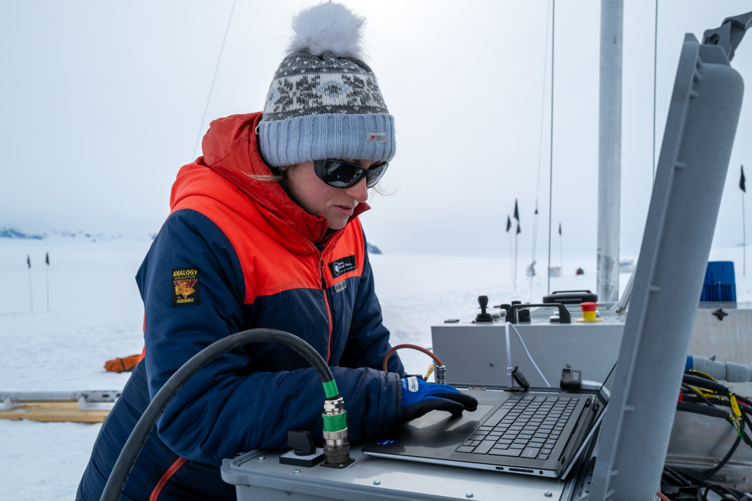
Emma Fisher tests new instrumentation at Union Glacier, Antarctica, during an ice drilling project.
Emma Fisher's path looks more conventional on paper, a mechanical engineering degree followed by a PhD researching jet engines, where she designed, built and tested bespoke instrumentation to study heat transfer and fluid flow through the engine, but the destination wasn't obvious from the start either. She's now an Ice Core Drilling Engineer, though the title undersells it: she applies that same skillset, designing, developing and testing bespoke instrumentation, to a very different application, spanning mechanical, electrical and software engineering, from rebuilding drills in the workshop to writing analysis software for ice cores and upgrading instrumentation on BAS's Twin Otter aircraft.
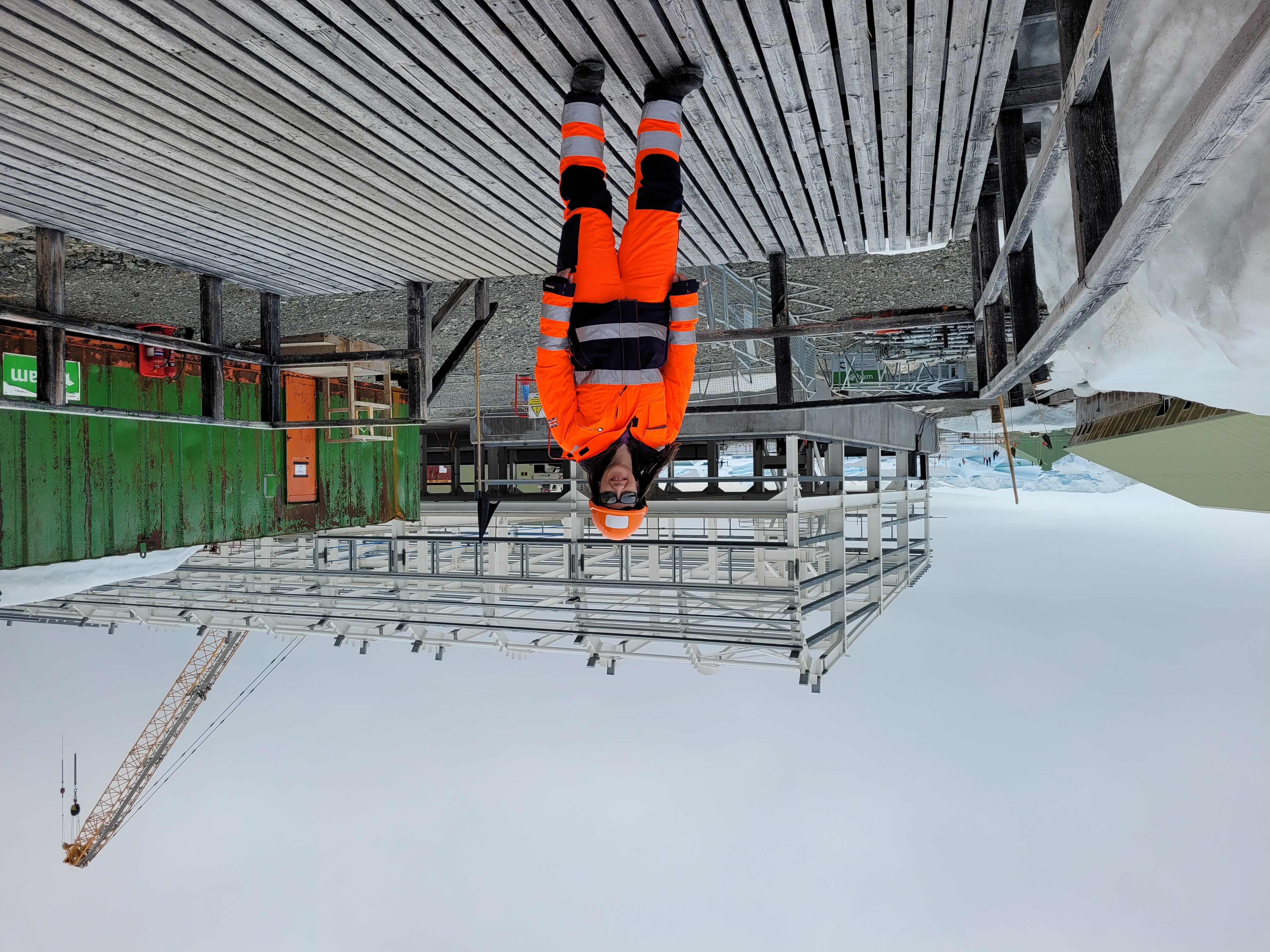
Elen Jones at Rothera during her first Antarctic deployment.
Elen Jones spent nearly eighteen years at Network Rail, starting as an electrical project engineer and working up to multidisciplinary infrastructure delivery, before joining BAS as Programme Director for the Antarctic Infrastructure Modernisation Programme, the organisation's largest investment in polar infrastructure since the 1980s. Her remit now spans engineering, programme management, finance and stakeholder engagement, and she has deployed to Rothera four times, including a twelve-week period overseeing the commissioning of the station's new Discovery Building, including resolving issues with the generators that keep the station powered and safe.
What the Job Actually Involves
None of the three describe a desk job. Rebecca's day starts with a walk around the entire Cambridge site, checking in on contractors and flagged jobs, from refrigeration and medical gases to electrics and plumbing. “You think it's an office-based job,” she says, “but basically I've got to walk around the whole site all day long.” Her estates team is five women to around twelve men.
Emma's week can swing from covered-in-grease workshop repairs to CAD design, electrical redesign, or writing software for scientists who come to her wanting something new built or measured in the field, work that keeps her role in Cambridge as varied as anyone's in the field.
Elen still gets hands-on time on station, but her role has broadened into the parts of a major programme that rarely make it into an engineering job title, budgets, delivery risk, and bringing people with her.
What's Changed in the Field, and What Hasn't
Emma has deployed four times into deep field camps. When she first deployed in 2023, she wasn't issued with urination devices and there were few options in women's field clothing. “It has got much better,” she says. “Now they do provide urination devices in kit bags and various other female products, and there are more options for women's clothing,”
Elen has seen a similar shift from the other side of it. Conversations about menstruating in the field, she says, used to be something “that's happening over there and let's not talk about it too much”; it's now covered explicitly in pre-deployment training. On clothing, she draws a direct comparison to her previous industry: “Railway industry PPE was all men's clothing. The first jacket I got could wrap around me at least one and a half times.” BAS's clothing manager, she says, actively pushes for properly fitting female PPE rather than leaving people to get kit altered themselves.
Being Heard
Both Emma and Elen were candid about moments where being underestimated wasn't hypothetical. Emma has had international collaborators take tools out of her hands, assuming she couldn't manage a task she was already doing competently and has sat in meetings where a male colleague in a similar role is addressed while she's ignored. She's also heard the line, “you've only got a job because you're a woman,” which she says leaves her feeling she constantly must prove herself in a way she doesn't think her male counterparts do.
Elen described carrying two toolboxes along a track, comfortably balanced, when a colleague took one off her unprompted, assuming she couldn't manage it. “He didn't do it again,” she says, “once they see that you're doing it and getting stuck in.” Both frame these as isolated moments rather than a pattern, more often unconscious than deliberate, but real in their effect.
Emma credits a year-long UKRI Women in Leadership course, alongside colleagues from BAS and Innovate UK, with giving her the confidence to challenge it in the moment rather than let it pass. She also points to a supportive line manager who checks in on her wellbeing, not only her workload, as making a tangible difference day to day. Elen has used mentoring and coaching throughout her career, including a coaching conversation prior to joining BAS that helped her confirm she wanted to stay in hands-on engineering rather than move fully into management. Rebecca, by contrast, says she hasn't sought out formal support of this kind and doesn't feel she's needed to.

Where Changes can be made
Asked what could potentially put a woman off applying for an engineering role at BAS, Emma and Elen converged on the same two answers. First, job adverts tend to list broad, generalist requirements spanning mechanical, electrical and software engineering, when most engineers specialise in one area. “Women will only apply for jobs if they meet most of the criteria,” Emma says, “whereas men might go for it if they only meet a few.” Elen agrees BAS “ask for quite a lot,” and argues that job descriptions rarely convey what an engineering role at BAS covers, generator mechanics, traverse teams, instrumentation, programme delivery, a breadth she thinks reads as overwhelming rather than inviting.
Second, the standard “up to three months' deployment a year” wording in job ads doesn't reflect how flexible that commitment can be and can deter women with families or those planning them, even when a given role might mean far less deployment than the wording implies, or none. Both suggested linking job ads to real stories about what the roles involve and being explicit that deployment can flex year to year. Cambridge hosts plenty of engineering work, but only a limited number of roles are entirely deployment-free, and both feel BAS still has some way to go in developing genuinely flexible, deployment-optional routes for those who need them.
Emma's closing point is one BAS may want to lead with rather than bury: you don't need prior polar experience or specialist polar knowledge to apply. “As long as you have a willingness to learn and apply your skill set to a new area,” she says, BAS will train you in the rest. It's a principle her own career already demonstrates: the same instrumentation skills she built studying jet engines now go into ice cores instead, the application changed, the underlying expertise didn't. Between them, the three women's own routes in, aquariums, jet engines, railways, make the same case without anyone having to say it directly.
Why BAS
Asked to sum up the organisation, all three of their responses land somewhere similar. “Everybody's really good at what they're doing, and it's different every day,” says Rebecca. Emma echoes it: “I love that every day I get to do something a bit different,” and points to designing instrumentation that helps understand climate change as part of what keeps her there. Elen frames it in terms of scale: being part of an organisation whose research shapes decisions well beyond BAS itself feels, she says, like “an incredible privilege,” and part of “something bigger than just your little bit.”

VERCIDA works with over one hundred clients who are committed to creating an inclusive work environment. If you are an employer and interested in working with VERCIDA to promote your culture and inclusion initiatives and attract the best candidates, please email [email protected] for more information.
 Help us find the best workplace for you by sharing more about yourself.
We will never disclose your information with others.
Help us find the best workplace for you by sharing more about yourself.
We will never disclose your information with others.
Learn more about this employer
British Antarctic Survey
Inclusive features
- No matching inclusive features