

Be the Change: Nadia Kanyike's Journey into Nuclear Engineering at Amentum
Category: Race, Ethnicity & Heritage, Generation (Age Friendly)

Meet Nadia Kanyike, a Planning Engineer at Amentum.
She has often been the only woman in the room, the only Black person, and the only Muslim. This is the story of how her mother's advice, one difficult presentation to a room of senior leaders, and Amentum's willingness to accommodate her needs helped her turn difference into purpose.
Written by VERCIDA for Amentum.
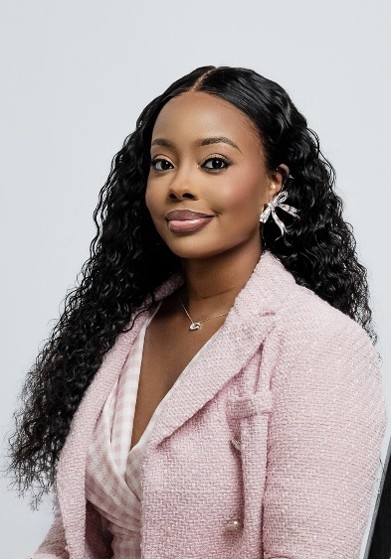
From an early age, Nadia knew that she wanted to work in project management, in a hands-on sector such as construction or engineering. Her mother warned her that these industries are heavily male-dominated and mostly white. Nadia didn’t allow this to deter her; instead, she was determined to pursue the career she dreamed of.
The sister who showed her the way
While studying for her degree, Nadia spent a placement year working in construction and engineering, and found she loved watching a project take shape from nothing, then following it through to completion. "It was something I was good at," she says. "I've always enjoyed watching how projects are built from scratch and seeing the end goal.”
Her parents hadn't worked in construction themselves, though back in their home countries they'd overseen the building of their own family homes. It was Nadia's sister, already working in engineering, who invited Nadia to shadow her on construction projects while still at university.
"I always knew I wanted to do something project management related," Nadia explains, and she joined Amentum's graduate programme with exactly that in mind. But her sister, a planning engineer, had a hunch Nadia might enjoy planning engineering more, and she was right. Her sister taught her P6, the industry-standard scheduling software, and planning engineering stuck. "That's why I'm doing it today," she says.
A typical day at work
Amentum's UK operation has grown quickly, with many new roles created across nuclear power and defence. Nadia's career sits inside that growth, in one of the less visible disciplines that keeps major infrastructure projects on track.
Her current role at Amentum supports the refurbishment of Royal Navy submarines. A typical day involves a lot of stakeholder management: chasing teams for progress updates to keep the P6 schedule current, chasing the client for decisions, chasing risk owners for mitigation plans. "I have to calculate the risks and costs and then review those with the team and the client," she says. If something is running late, it falls to Nadia to flag it and find a way through.
It isn't all screens and spreadsheets, though. Last week, Nadia spent three days on site in Scotland, checking that the situation on the ground matched the schedule. It’s her job to organise the project and make sure everything is going to plan, and if it's not, to identify what needs to happen next.
The only one in the room
Nadia's mother started preparing her for her desired career path from an early age. She sent Nadia to an all-girls science, technology, engineering and mathematics (STEM) school and Nadia quickly found that her mother was right in terms of construction and engineering being very male-dominated industries. During her placement year, she was the only woman and the only person of colour on her team. Her confidence was the lowest it’s been during this time; she had to learn how the corporate world worked while visibly being the odd one out. The people around her were kind, she says, but that didn't change the dynamics of the room.
What kept her motivated was something her mother taught her from childhood, a line Nadia attributes to Gandhi: “You must be the change you wish to see in the world.” Nadia says her mother's advice was blunt: keep going, because the people who come after her are going to need some sort of representation. If Nadia wants to see more of these girls who looked like her in the workplace, then she must help open the doors for them.
The same line explains the pressure Nadia puts on herself now. "It's my character," she says. "I like to help people. If I have the resources to help people, I feel like I should." Being visible as a role model, in her view, comes with a responsibility to carry yourself a certain way, and that pressure isn't something her mother imposed: it comes from having seen the effect her actions have had on other people and makes her feel like she is doing the right thing.
The presentation that changed everything
The real turning point was a presentation to Amentum's senior leaders on what she'd learned so far during the graduate programme. Preparing it, she found herself comparing her own trajectory - extreme lows and comparatively few highs - with the seemingly smoother paths of the colleagues presenting alongside her, in front of a board that was itself largely white and male.
Afterwards, people praised the highs. But nobody mentioned the lows.
She realised that no matter how much she sat there and complained or expected sympathy from people, things wouldn’t change unless she did something about it herself. Nadia started speaking plainly about her own experience. "Closed mouths don't get fed," she says, quoting a line from her best friend that she now lives by. Before, she used to close her mouth and didn't get the opportunities she deserved.
Since then, Nadia has joined ABE, Amentum’s Black Excellence employee network, which helps to attract and champion more young Black talent into the business. She also undertakes charity work in the same space outside her day job. She believes that these opportunities opened up for her because she was her true self and spoke up for change.
A prayer room, almost by accident
Being a Muslim Black woman in an overwhelmingly white, male-dominated sector is, in Nadia's words, an intersection she doesn't see very often.
When Amentum opened a new office in London Bridge, Nadia went along for a tour. It happened to be Ramadan. She mentioned this to the facilities manager, more in passing than as a request, and his response was immediate: one of the rooms, originally set aside as a general wellbeing space, could become a prayer room instead.
For Nadia, that wasn't a small thing. During her placement year, she'd had to find her own space to pray each day during Ramadan, with no designated area in the building itself. "It was really difficult," she says. "They were supportive, but there was nowhere assigned for people to go and pray."
Working with scoliosis
Nadia has scoliosis, a curvature of the spine that makes long walks and extended sitting difficult. She was open about her restrictions with her manager from the start.
The result has been small, consistent adjustments sustained over years rather than granted once and forgotten. An example is funding the cost of a taxi for travel between a train station and client office or site, to limit the amount of walking she has to do.
Alongside this, Nadia has a flexible working pattern which allows her to work from home when required, and to flex her work commitments around her medical appointments. Once the initial conversation with her manager happened, the accommodations simply travelled with her, project to project. "I'm very grateful," she says, "because I'm not sure that every company would be as accommodating.”
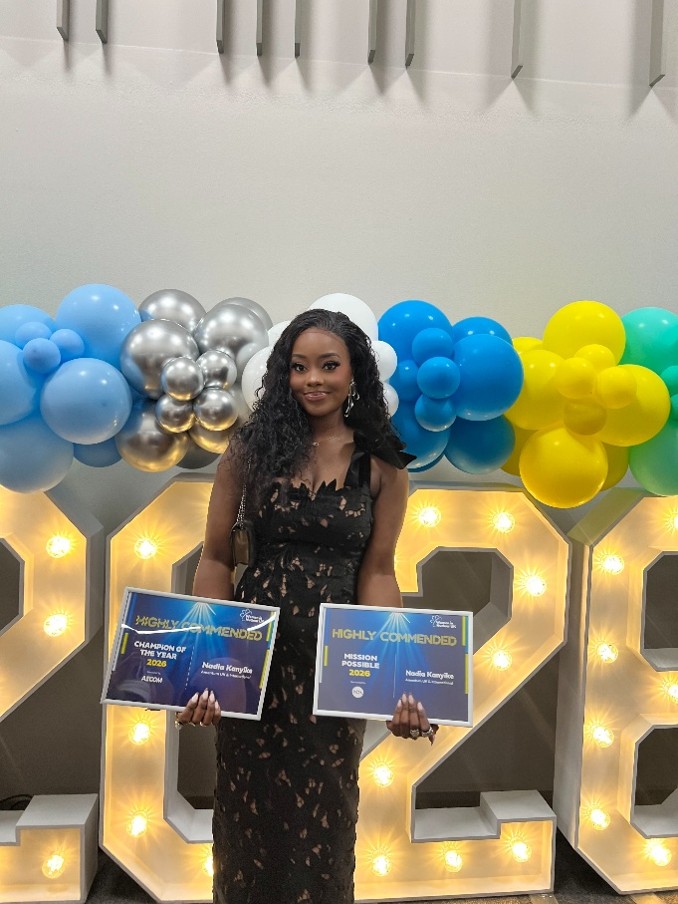 Nadia at the Women in Nuclear awards
Second place, and what it means
In May 2026, Nadia was a highly commended runner-up in the Champion of the Year category of the Women in Nuclear awards, recognition from an organisation with no obligation to notice her at all. That, she says, is exactly what made it matter. "These external organisations are recognising my mission behind everything I do."
She's clear, too, about who the recognition is really for. Growing up, Nadia sat through school careers fairs where visiting professionals talked about all sorts of exciting futures, but none of them looked like her. This doesn’t provide the motivation a young person needs - they need to see it to believe it. Being a role model in the engineering sector means that more young Black girls can now look at Nadia and see themselves in her.
Her message to the next generation
Asked what she'd want a young Black woman, who is unsure whether engineering or the nuclear sector is really for her, to take from this article, Nadia doesn't hesitate.
"The only reason I'm in this position is because I put myself in those rooms," she says. "You have to put yourself forward to even be seen, or recognised, or remembered. It's always the first step."
Hiring more Black people, in her view, solves only half the problem if organisations don't understand what happens after the hire. It's not about hiring different people from different backgrounds, it's about how they are made to feel once they're inside the organisation.
What keeps Nadia motivated is treating something many people would see as a challenge as an advantage instead. Being visibly different from the majority motivates her to champion more young Black women to consider roles like hers. "I've navigated some of the rough roads to try to make it a little easier for those who are travelling along them after me.”

VERCIDA works with over one hundred clients who are committed to creating an inclusive work environment. If you are an employer and interested in working with VERCIDA to promote your culture and inclusion initiatives and attract the best candidates, please email [email protected] for more information.
 Help us find the best workplace for you by sharing more about yourself.
We will never disclose your information with others.
Learn more about this employer
Amentum
Inclusive features
- No matching inclusive features