

Finding the Signal: My ADHD Journey on the Railway
Category: Neurodiversity

Hear directly from Stuart Jones, a Train Driver at TransPennine Express
I have been with TransPennine Express for nearly two decades, spending the last 12 years as a Train Driver. Interestingly, I was diagnosed with ADHD eleven years into my driving career. This is my story, and the message I want every neurodivergent jobseeker to hear.

For years, I felt like I was working against a current I could not see. I did not know why
certain things were so hard. I did not know why I could absorb a whole route, recite every junction on the way to York, and still feel like I was only just holding on. I spent over a decade as a Train Driver before I had any of the answers. And when they finally came,
everything changed.
This is my honest account of life before and after my ADHD diagnosis, the struggles I did not have the language for, the moment things clicked into place, and what I have learned along the way. If you are neurodivergent and wondering whether a career in rail is for you, I hope my story helps.
Starting Out: When the Novelty Did the Work for Me
When I first started training as a driver, everything was new, everything was interesting, and my brain just locked in. That is what ADHD brains do with novelty, they hyperfocus. I did not know that at the time. I just thought I was getting lucky.
While my classmates went home to revise each evening, I went out running. And I could still pass the tests. The routes, the rules, the mechanics of driving the train, it all went in. I was in a classroom of ten people, most of them colleagues I already knew from my days as a conductor, and the energy was great. I was focused. I was engaged. I felt fine.
The cracks started to show during the weekly exams. I hated being tested. The anxiety would kick in, and I would just want to get it over with. I would race through the paper, miss out words, and hand it in first. My trainer would look at me and say, Stuart, you passed — but what does this mean? He knew I knew the material. The problem was I could not sit with the discomfort of being assessed. I would rather get out of the room than get a perfect score.
It was only after a year or so of solo driving, once the novelty had worn off and the routes felt familiar, that things started going wrong. My brain was no longer captivated by the new, and it started to wander. I did not know why. I just thought I was not cut out for this.
The Diagnosis: A Long Road to Clarity
My path to diagnosis was not a straight line. For years, I would be driving my train or my car and just start crying, for no reason I could explain. I was genuinely happy in my personal life, happier than I had ever been, but something was clearly not right.
It was my now-wife, Donna, who forced the issue. She is a specialist in Special Educational Needs and she had been watching me for a while. One night she said: someone who is happy does not sit on the sofa crying most nights. I told her I was fine. She told me I was not. And she was of course right.
She made me go to my GP. I was referred for talking therapy, and in the very first session, the therapist said she thought she was seeing ADHD. She could not formally diagnose me, that required a specialist, but she put me on the waiting list. Twelve months, I was told.
During that wait, a significant incident at work shook me badly. I could not explain what had happened or why. I was terrified that if I told the company I thought I might have ADHD, they would use it as a reason to take my licence away. So I stayed quiet and waited.
Eventually, Donna and I decided to go private. From my first phone call to my diagnosis and starting medication, the whole process took around eight weeks. And the change the medication made was immediate and massive. Things that had always felt chaotic suddenly had a shape to them. I finally understood what had been going on all along.
Know Your Options: NHS Right to Choose
Something I only found out after going private: everyone in England has the right to choose how they receive NHS care. If you are on a waiting list for an ADHD assessment, you may be able to self-refer, or ask your GP to refer you, to an alternative approved provider, often with a much shorter wait.
ADHD Right to Choose has a list of approved providers. Some are fully NHS-funded; others may involve a small contribution. Waiting times can be as short as 16 weeks. I wish I had known about this sooner.
Life in the Cab: Before and After
Before my diagnosis and medication, driving was exhausting in a way I could never quite explain to anyone else. I sat on the edge of my seat for every shift. Everything was reactive. I would hear other drivers in the mess room talking about where they shut off the power, where they started braking, like they had a settled, reliable plan in their heads and I genuinely thought they were making it up. I did not have that. Every journey felt slightly new, slightly different.
A few days after starting my medication, I noticed something. I was doing the same things, shutting off at the same points, coasting through the same curves, and I suddenly realised: I have always done that. My brain had learned the routes. It had built a plan. I just had never been able to access it consciously before.
That was a strange and wonderful moment. I had the same thing as every other driver all along. I just could not recognise it as a pattern. Now I am far more relaxed in the cab. I feel in control. And I genuinely believe I am a safer driver for it.
Coming Forward: How TPE Responded
Telling my employer was not a decision I took lightly. I had spent months convinced that disclosing an ADHD suspicion would cost me my career. That fear, I now know, was not grounded in reality but when you are undiagnosed and struggling to explain your own behaviour, everything feels like a risk.
My driver manager first noticed because of the psychiatric appointment letters I was submitting. He rang me. His first words were: I can see what these appointments are for, do you need anything from us?
When I texted him after my diagnosis, he replied straight away. He was measured, calm, and practical. He said: let me know what the medication is and we will go from there. During my titration period (the months of monthly dose adjustments) I was given 48 hours of restriction after each change and time off for my medical appointments. Once my dose was stable, everything went back to normal.
I will be honest: at the time, I had made peace with the idea that I might have to step back from driving. My family mattered more than my role. But it never came to that. TPE supported me through the process, and I came out the other side in a better position than I had ever been in.
I have never needed to formally request reasonable adjustments. But I genuinely believe that if I did, they would find a way to make it work.
Building Something Bigger
Since my diagnosis, I have wanted to do more than just manage my own ADHD. I now co-lead the Neurodiversity Network at TPE — a growing group of colleagues who share experiences, support each other, and work to make the organisation better for neurodivergent people and allies at every level.
One of the things I have pushed for is genuinely simple: when a manager sends a message asking someone to come and see them, they should say what it is about. I always assume the worst. Even now, even when I know I have done nothing wrong, a message that just says, ‘can you come and see me?’ sends me into a spiral. It is usually just to sign a form or something simple but by the time I find that out, I have spent half the day convinced I am losing my job.
So, I started asking just to add one line. ‘Can you come and see me — I need you to sign some rule book amendments.’ That is it. That is all it takes to make a huge difference to someone like me. I also ran a company-wide survey on communication, reaching colleagues across all grades. The data is now being used to shape how leadership communicates with staff; clearer, more direct, less jargon.
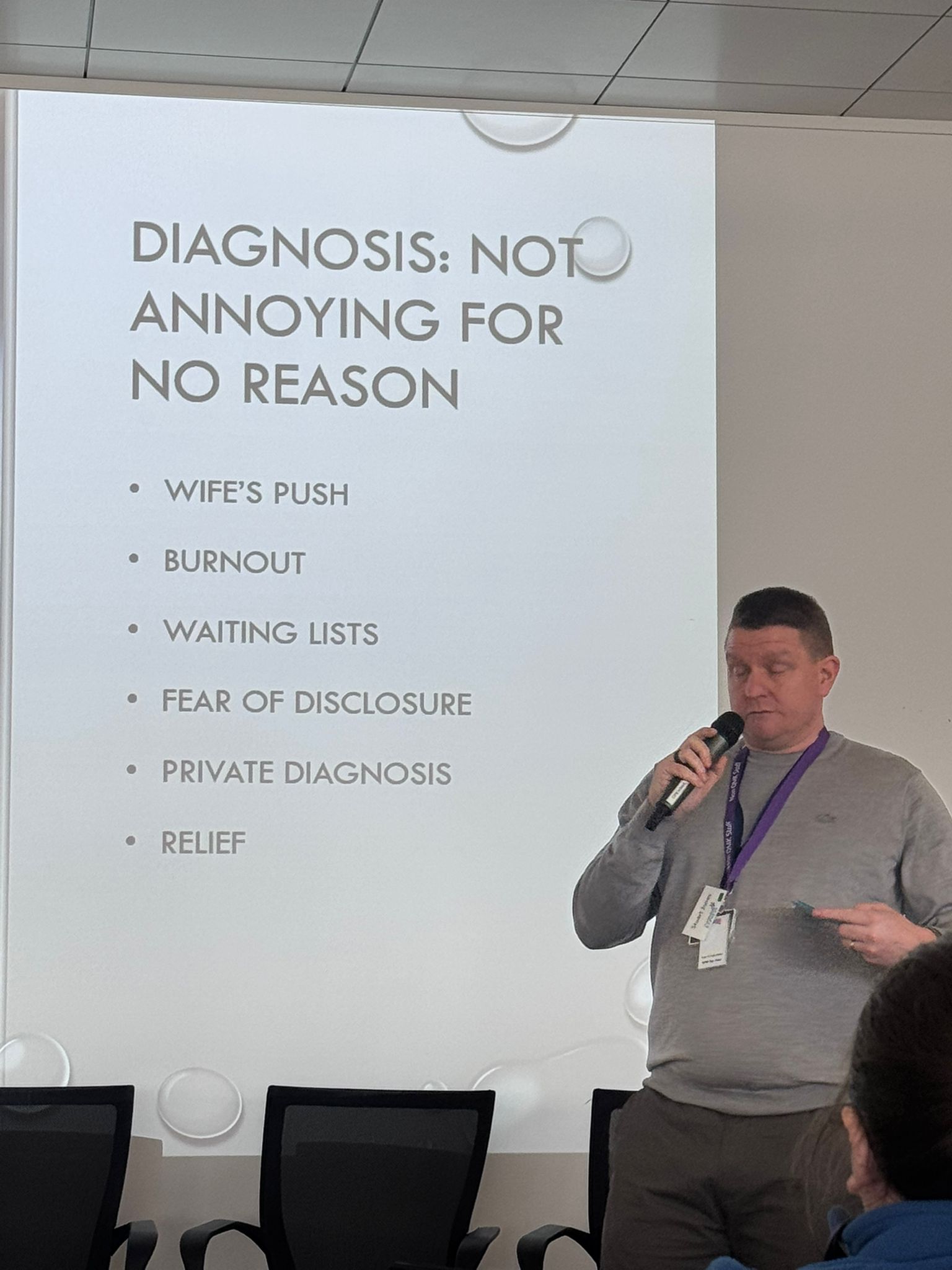
I have spoken at the Neurodiversity and Rail Conference on TPE’s behalf. Throughout this journey, our DEI lead, Jane, has been an incredible champion. She recognises that while ADHD can bring challenges and heartbreak, it also brings immense strength. Jane is dedicated to highlighting the power of different brains across our network, ensuring everyone feels safe to be themselves without masking. To Jane, my ADHD is a strength; to me, it is simply who I am. I continue to share my story for those still struggling in silence, helping them understand they aren't alone.
What I Want You to Know
If you are neurodivergent and wondering whether a career in rail is possible for you, my first piece of advice is this: do not Google it.
I made that mistake. The online forums are full of outdated information, particularly around medication and safety-critical roles. I read that stimulant medication would disqualify me from driving trains. I read that ADHD meant I could not concentrate enough for this kind of work. None of it is true. I drive trains on ADHD medication. I know conductors, drivers, and colleagues across all grades who are neurodivergent. Autistic people drive trains. People with Asperger’s drive trains. It is not the barrier the internet makes it out to be.
You are not legally obliged to tell your employer you think you might be neurodivergent, especially if you are not yet diagnosed or not yet on medication. That is your personal information. But I would encourage you to be open when you can, because the more employers know, the more they must do something about it. Every person who discloses makes it easier for the person who comes next.
I joined TPE on a six-month temporary contract in 2006. I am still here. It is a good job, a good career, and a workplace that, in my experience, genuinely tries to do right by its people. If this is the kind of work you want to do, apply. Try your best. Do not let a Google search make the decision for you.
Stuart is a Train Driver at TransPennine Express and co-leads the TPE Neurodiversity Network. Looking for an employer that genuinely supports neurodivergent professionals? Explore inclusive employers on VERCIDA today.

VERCIDA works with over one hundred clients who are committed to creating an inclusive work environment. If you are an employer and interested in working with VERCIDA to promote your culture and inclusion initiatives and attract the best candidates, please email [email protected] for more information.
 Help us find the best workplace for you by sharing more about yourself.
We will never disclose your information with others.
Help us find the best workplace for you by sharing more about yourself.
We will never disclose your information with others.
Learn more about this employer
TransPennine Express
Inclusive features
- No matching inclusive features