

Harbottle & Lewis' Yvonne Gallagher Featured in Law360’s Expert Analysis Series
Category: Generation (Age Friendly), Career Resources

Partner and head of our employment practice, Yvonne Gallagher, has been featured in Law360‘s UK Expert Analysis series, where practice group leaders share their perspectives on the current market landscape and insights from their professional experience.
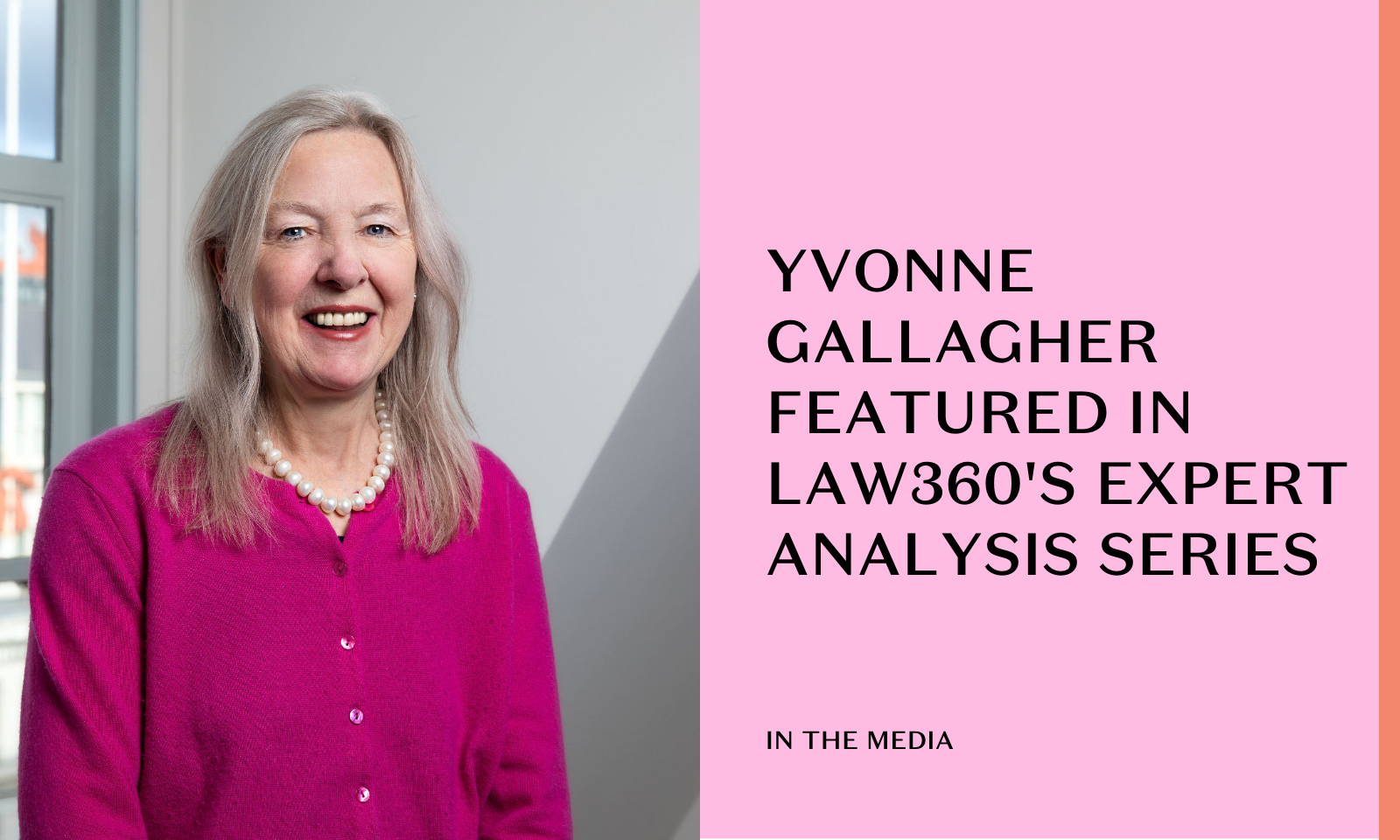
Yvonne discusses the challenges of dealing with clients’ emotions, the significance of the widening scope for discrimination disputes, and why junior lawyers should focus on learning the basic contractual and statutory principles of employment law.
The Most Challenging Matter I've Worked On
Many of the matters we deal with as employment lawyers are challenging, so it is very difficult to single out examples. As well as dealing with a wide-ranging and fast-moving body of law, we are dealing fundamentally with a relationship that is of key importance to individuals, and their lives and families. This can lead to the adoption of rigid positions, which can make it hard to find a resolution.
Time pressure is often a big feature, where we are working to meet challenging deadlines while communicating with a number of parties or stakeholders. This is exacerbated by time zone differences.
In recent examples of challenging work, the issues are often driven by the anger of parties on all sides at the nature of claims made and the response to them, and we all have a job to do in finding ways to take our clients through that.
A recent example involved a case where the individual held awards of shares and options with the potential to have significant value, though of course there was no guarantee.
As well as such cases potentially giving rise to additional claims under the Companies Act 2006, where unfair prejudice to a minority shareholder is alleged, the value, sense of ownership and status within the business that come with significant equity interests can add to the sense of injustice that an individual feels when their employment comes to an end.
Such disputes are becoming more common, and dealing with different claims running simultaneously in the employment tribunal, the High Court and courts in other jurisdictions, where multinationals are involved, itself, adds to the complexity, costs and pressure felt by clients on each side.
Laws and Regulations in Need of Reform
This is perhaps not purely a law or regulation issue, but the immense delays in the employment tribunal system are not operating to anyone's benefit.
It is not unusual for final hearings to take place more than a year after a dispute has arisen, which does not help parties move on from whatever caused the issue.
The employment tribunal has also become a much more legalistic forum than originally intended. (This is a bit rich coming from a lawyer, I know, but it is true.) It would be good to find a way back to a more practical and swift means of disposing of workplace disputes.
Important Developments and Trends I'm Tracking
There is no doubt that increasing legislation has multiplied the number and type of claims that can be brought. Therefore, the scope for dispute has widened.
The category of protected characteristics in the Equality Act 2010 has rightly widened — until the 1990s, discrimination claims were very much limited to discrimination on the grounds of sex or race, neither of which were disputed categories, at that time, in terms of eligibility to claim protection.
The addition of the protection of religion and belief has achieved a lot of good work in minimizing unfair discriminatory conduct and treatment, but it has also introduced a need to examine some necessarily subjective beliefs. Further, it has given rise to scope for difficult conflicts between those who hold sincere, but different, beliefs on fundamental aspects of human life.
Similarly, and for good on the whole, the protected category of disability is surely far wider in scope than was envisaged when it was introduced in 1995, at which time the focus of commentary was very much on physical disabilities and adjustments to physical features in the workplace.
The pending extension of unfair dismissal rights to offer protection from the first day of employment has the potential to significantly increase the number of claims being made.
While it appears likely that some form of a probation period, and a simpler termination process during that period, will be permitted, there must be concern that employers will be worried about an increased risk of claims, and so will be reluctant to hire.
This may be especially the case where a candidate doesn't have a proven track record in the role or sector in question, and where an employer might otherwise feel inclined to take a chance on a promising individual. Ultimately that outcome is not good for employers, job hunters or the economy, even if it does generate more work for employment lawyers.
A Lawyer I Admire
Peter Daly at Doyle Clayton Solicitors Ltd. has been hugely impressive in representing those who have challenged discrimination on the grounds of gender critical belief.
At the outset, it was far from obvious that the Equality Act's protection from discrimination on the grounds of religion or belief would extend to these claims.
However, a thorough and coherent presentation of the arguments did persuade the Employment Appeal Tribunal in Forstater v. CGD Europe, and any number of subsequent tribunal panels.[1]
In terms of personal dealings, lawyers who work to cut through the emotions to get to practical solutions for both sides really make a difference. I have met many over the years who do this very effectively.
Most recently, I mention Nicola Walker of Womble Bond Dickinson (UK) for her approach to a matter in which each of our clients had great determination and strong, but differing, views on what had happened, but her method enabled a constructive and pragmatic approach to bear fruit.
My Advice to Junior Lawyers
We are lucky to work in an area of law that has relevance to everyone who works.
The nature of the legal relationships we deal with is understandable from the first exposure a lawyer has to it — we have pretty well all been employees at some point in our lives — so for trainees and juniors, there is an immediate point of connection.
We are lucky to have a lot of law, both statutes and never-ending case developments to get to grips with, all in the context of the endless variety that is contained in humanity itself, so it is impossible to be bored as an employment lawyer.
Throw yourself in, be aware of the emotions involved, as well as the legal rights and obligations, and recognize that you can't possibly know all the answers in your early years.
It takes a while to develop good judgment on even the fundamental questions, such as "Does this amount to gross misconduct?" or "Is it reasonable in all the circumstances to terminate?"
New scenarios endlessly arise — we have truly never seen it all. So, focus on getting to grips with the basic contractual and statutory principles, and don't ever be afraid to ask questions.

VERCIDA works with over one hundred clients who are committed to creating an inclusive work environment. If you are an employer and interested in working with VERCIDA to promote your culture and inclusion initiatives and attract the best candidates, please email [email protected] for more information.
 Help us find the best workplace for you by sharing more about yourself.
We will never disclose your information with others.
Help us find the best workplace for you by sharing more about yourself.
We will never disclose your information with others.
Learn more about this employer
Harbottle & Lewis
Inclusive features
- No matching inclusive features